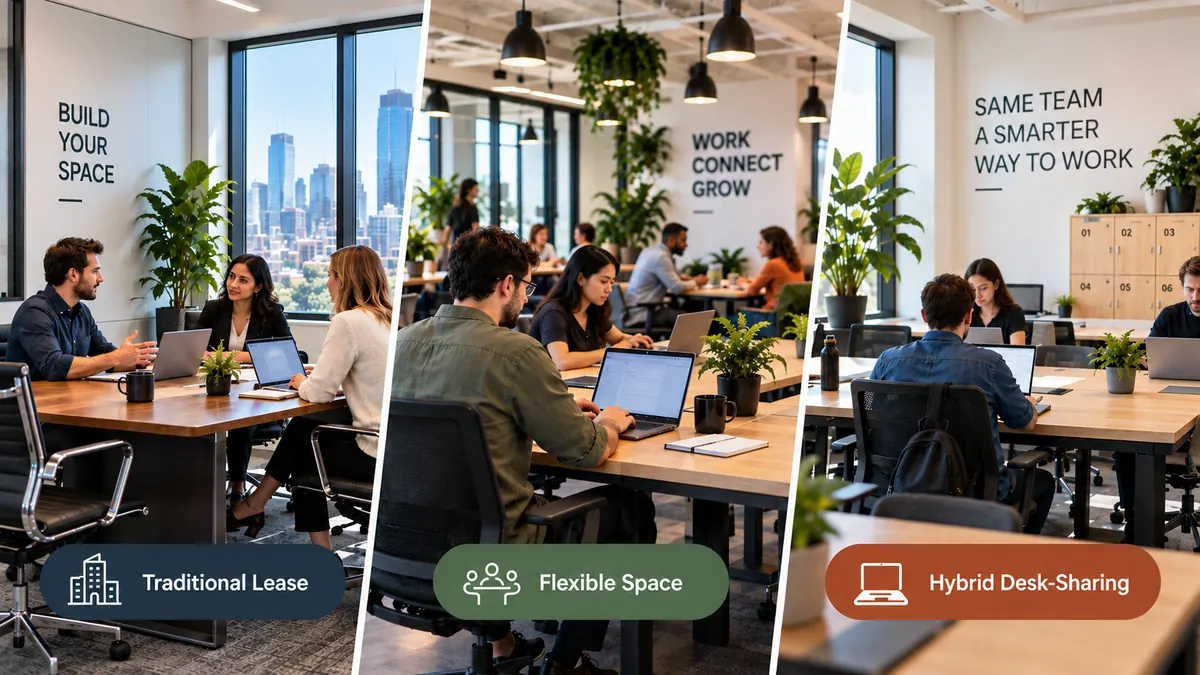
If your growing team has moved beyond home offices, coffee shops or occasional coworking day passes, you're facing a real structural decision, not just a budgeting question. A traditional commercial lease, a flexible coworking membership and a hybrid desk-sharing arrangement aren't three price points on the same product — they're three different commitments, with different exit terms, different ownership of the furniture and buildout, and very different amounts of room to change your mind as headcount moves.
This article focuses on the structure of each arrangement rather than quoting prices that vary by market, building and contract. The key questions are: how long you're locked in, what happens if you need to add or shed desks, how private the space is and what it actually takes to switch if the arrangement stops fitting.
Three ways to house a growing team
Most small teams end up choosing between three structurally distinct options, sometimes without realizing the other two exist as real alternatives.
A traditional commercial lease
A direct lease is a contract with a landlord for a fixed amount of square footage, typically running several years rather than months. You're usually the one arranging the buildout — walls, cabling, furniture — either paying for it yourself or negotiating a tenant improvement allowance from the landlord that gets built into the lease terms. Many landlords also require a personal or corporate guaranty, particularly from a small or newer business without a long financial track record.
The appeal is control: your name on the door, your own layout, no shared common areas and no one else's meeting schedule competing for a room. The trade-off is that you're committed to that square footage and that rent for the length of the term, regardless of whether your headcount goes up, down or sideways in year two.
A flexible or coworking membership
A flexible-workspace or coworking membership puts your team into space the operator already built out and furnished — usually a cluster of dedicated desks or a private office suite within a larger building, rather than your own standalone floor. Contracts run month-to-month or on a short annual term far more often than the multi-year terms typical of a direct lease, and the operator, not you, owns the desks, chairs and buildout.
That arrangement trades some control for flexibility. You generally can't customize the space as freely as you could in your own leased floor, and you're sharing a building's common areas, wifi and sometimes meeting rooms with other member companies. In exchange, adding a desk or two as you hire is usually a matter of asking the operator what's available, not renegotiating a lease.
Hybrid desk-sharing
Hybrid desk-sharing is a variation on the flexible-membership structure, not a separate category of building: it's the same kind of coworking or flexible-office membership, sized for fewer desks than your total headcount because not everyone is expected to be in on the same day. A ten-person team might hold six or seven desks rather than ten, assuming a few people are usually remote, traveling or working a hybrid schedule.
The structural trade-offs mirror flexible space — short commitments, operator-owned buildout — with one added variable: desk availability now depends on how well your assumed attendance pattern matches what actually happens week to week. If more people show up on a given day than you have desks for, someone works from a common area, a day pass gets bought for the day or the team quietly reverts to a rotation that undermines the whole point of the arrangement.
| Attribute | Traditional lease | Flexible/coworking membership | Hybrid desk-sharing |
|---|---|---|---|
| Typical contract length | Multi-year terms are common, especially for build-out-heavy space | Month-to-month or a short annual term is common | Same as a flexible membership — month-to-month or short annual term |
| Who owns the buildout and furniture | Ownership and removal obligations depend on the lease; the tenant may fund improvements, sometimes with a landlord allowance | The operator generally provides the furniture and fit-out; check what is included | The operator generally provides the fit-out, as with other flexible memberships |
| Ability to add headcount | Limited to your leased square footage until the term ends or you renegotiate | Usually possible by adding desks, subject to what's available in that building | Possible up to the desk-sharing ratio you set — beyond that, you're adding desks like any flexible membership |
| Ability to shrink headcount | Difficult — you generally keep paying for the full square footage unless you sublet | Easier — many operators allow dropping desks at renewal or with notice | Built in by design, but only if your attendance assumption was realistic to begin with |
| Privacy level | Potentially high within the leased premises; building access and shared facilities vary | Depends on the tier — a private office suite offers real privacy; open dedicated desks share common areas | Depends on whether the team uses shared desks or an enclosed private suite, and on access arrangements |
| Notice period to exit | Notice and early-exit rights depend on the signed lease; there may be no contractual early-exit right | Notice and minimum-term rules vary; confirm them in writing | Same notice structure as a flexible membership, since it's the same kind of contract |
| Disruption when switching arrangements | High — physical move, IT and cabling reconfiguration, address changes, disposing of or moving owned furniture | Lower — no owned buildout to move, though address changes and IT reconfiguration still apply | Lower, same as flexible space, plus re-communicating a new attendance or booking pattern to the team |
Contract length and how hard it actually is to leave
The headline term length matters less than what happens if you need to leave before it's up, and that's the question most first-time tenants forget to ask until they're already stuck. A multi-year commercial lease typically includes a formal process for early termination — the agreement may provide a negotiated break right, require payment of a termination amount, or offer no unilateral early-exit right. Subletting or assigning the lease may require landlord consent and may not release you from your obligations.
Flexible and coworking memberships are built around shorter horizons by design, but "month-to-month" doesn't always mean you can walk away tomorrow. Most operators require written notice — a specified notice period — and some longer-term membership discounts come with their own minimum-stay clause that reintroduces some of the lock-in a month-to-month plan is supposed to avoid.
Room to grow — or shrink — without starting over
A team of seven today might be twelve in eighteen months, or it might stay at seven, or it might contract if a contract falls through. Each of the three structures handles that uncertainty differently.
A traditional lease locks in square footage for the term regardless of what headcount actually does. Outgrowing the space can mean negotiating for adjoining space, relocating or waiting out the term — none of which happen quickly. Shrinking may leave you paying for space you no longer need unless a permitted sublease, assignment or negotiated change is available.
A flexible membership handles both directions more gracefully, within limits. Adding desks usually means asking the operator what's available in that building — which isn't guaranteed, especially in a popular location where the operator may be near capacity. When comparing locations, browse coworking spaces in New York City to identify operators you can ask about team expansion options. Shrinking is typically easier than in a direct lease, since most operators let you drop desks at renewal or with the standard notice period rather than locking you into unused capacity for years.
Hybrid desk-sharing adds a layer of built-in flex — it's designed to absorb some headcount growth before you need to add desks, since the desk count was never meant to equal headcount in the first place. But that only works if the underlying attendance assumption holds. A team that quietly shifts from mostly-remote to mostly-in-office won't feel the mismatch in the contract; they'll feel it as a shortage of desks on a Tuesday morning.
Privacy, confidentiality and team culture
Privacy isn't one setting you either have or don't — it varies by tier within flexible space just as much as it does between a lease and a membership. An open dedicated-desk cluster inside a coworking building offers little more acoustic or visual privacy than a well-run open-plan office, with the added factor of sharing the floor with other companies you don't control. An enclosed private office suite can offer more visual and conversational separation, but sound insulation, operator access and shared facilities still need checking.
If your team regularly handles confidential client conversations, sensitive data discussions or work that benefits from consistent, controllable surroundings, that's a real factor independent of contract length or cost. It's worth walking a specific space in person and asking pointed questions about wall construction, sound transfer between offices and who else has access to your floor — rather than assuming "private office" means the same level of privacy at every building.
What switching actually costs you in disruption
Every comparison of these three options eventually runs into the question of what happens if you switch — and the disruption deserves attention alongside the financial implications. Moving out of a traditional lease means physically relocating furniture you own, reconfiguring or replacing cabling and network equipment, updating your business address everywhere it's registered, and coordinating a moving day that may interrupt work unless the move is carefully staged.
Moving out of a flexible membership is structurally lighter, since you never owned the buildout to begin with — there's no furniture to sell, store or haul. You still have an address change to manage and IT to reconfigure, but the physical move may be simpler, depending on the team’s equipment and the operator’s exit requirements. That difference in switching cost is part of why flexible space appeals to a team that isn't confident its headcount or budget will look the same next year.
What should tip your decision
How confident are you in your headcount trajectory
If headcount and space needs are relatively predictable, a longer lease may be easier to plan around. If growth or contraction is genuinely uncertain, that same lock-in becomes the biggest liability in the decision.
How much privacy does the work actually require
Client confidentiality, sensitive data or a culture that depends on consistent, controlled surroundings pushes toward a private office — whether that's a traditional lease or a private-office tier within flexible space — over an open desk arrangement.
How much capital can you tie up in a buildout right now
Financing your own fit-out and furniture ties up cash a growing business may need elsewhere. An operator-provided fit-out can reduce the need for an initial tenant-managed project, in exchange for less customization and control.
How predictable is your team's in-office attendance
Hybrid desk-sharing requires a workable attendance pattern and a plan for peak days. A team that's mostly in-office five days a week won't benefit from a shared-desk ratio built for a pattern that doesn't actually happen.
Questions to ask before you sign
The right questions get you a clearer answer than asking a landlord or operator to simply describe their space. They're different questions depending on which side of the comparison you're talking to.
Questions for a landlord or broker on a traditional lease
Traditional lease due diligence
- What is the exact term length, and what happens if I need to exit before it ends?
- Is a tenant improvement allowance included, and what happens to unused allowance or overruns?
- Am I personally or corporately guaranteeing this lease, and for how long does that guaranty apply?
- What are my rights to sublet or assign the lease if my space needs change?
- How much notice do I need to give before renewal, and what happens if I miss that window?
- Who owns the furniture and buildout at the end of the lease term?
Questions for a flexible-space or coworking operator
Flexible-membership due diligence
- What's the actual notice period to cancel or downgrade, in writing rather than a verbal estimate?
- If we grow, is there space in this building to add desks, or would we need to look elsewhere?
- If we shrink, can we drop desks at renewal, or are we locked in for the full term regardless?
- For a desk-sharing arrangement, what happens on a day more people show up than we have desks for?
- What level of privacy does our specific space offer, and who else has access to that floor or area?
- Is there a minimum-stay clause tied to any discounted rate, and what would break it?
Getting specific written answers to these questions before you sign anything tells you far more about how the arrangement will actually behave a year from now than the headline term length or the tour of the space does. If you're weighing options, you can browse coworking spaces, private offices and meeting rooms across the US through the BestCoworking U.S. workspace directory and contact operators directly to ask these questions against a specific building before you compare it to a lease.